What Should a Water Softener Look Like Inside? A Guide for Friendswood Homeowners
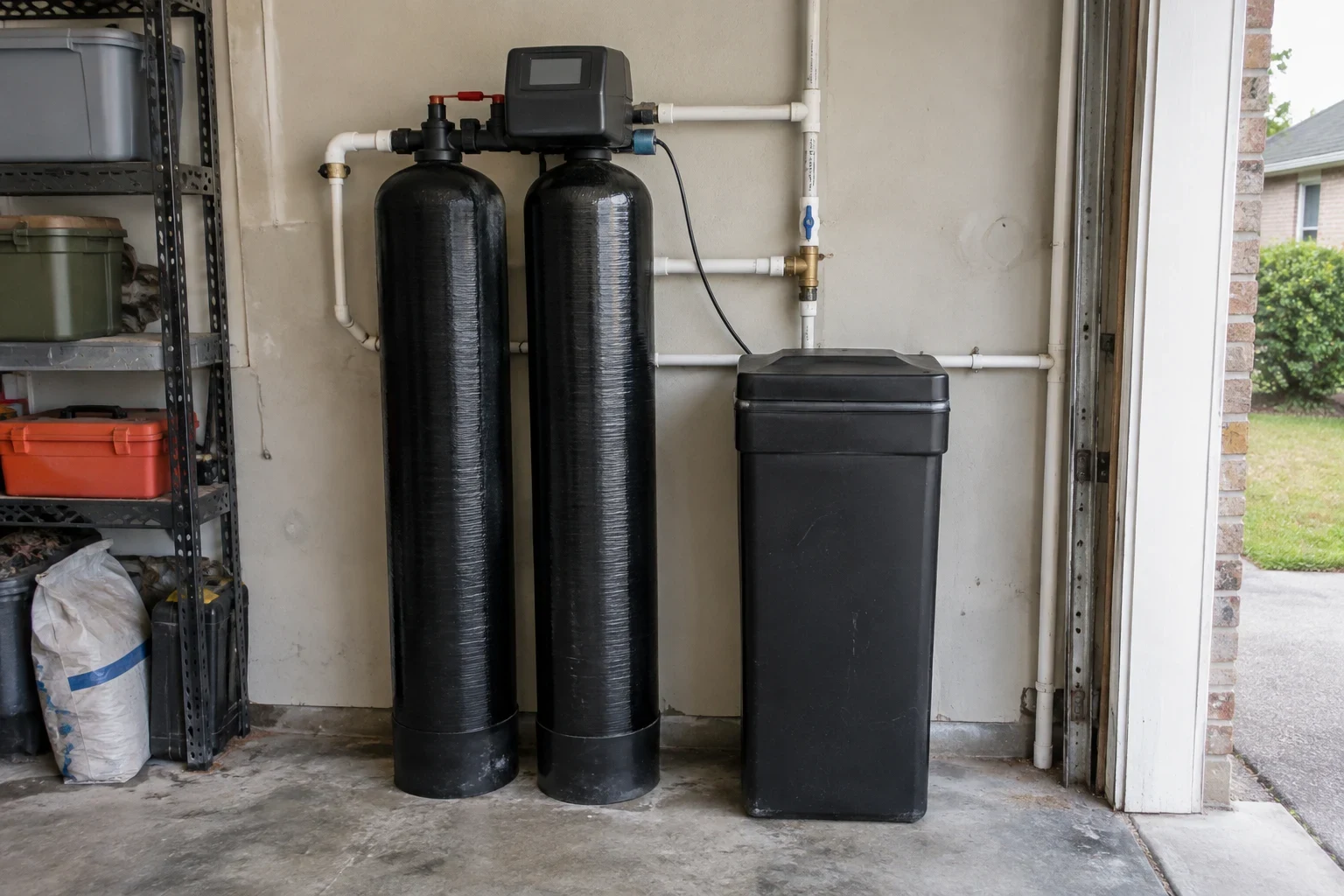
A softener is mostly two tanks and a valve, and a quick look at each one tells you a lot about how well it was installed and how long it will keep working.
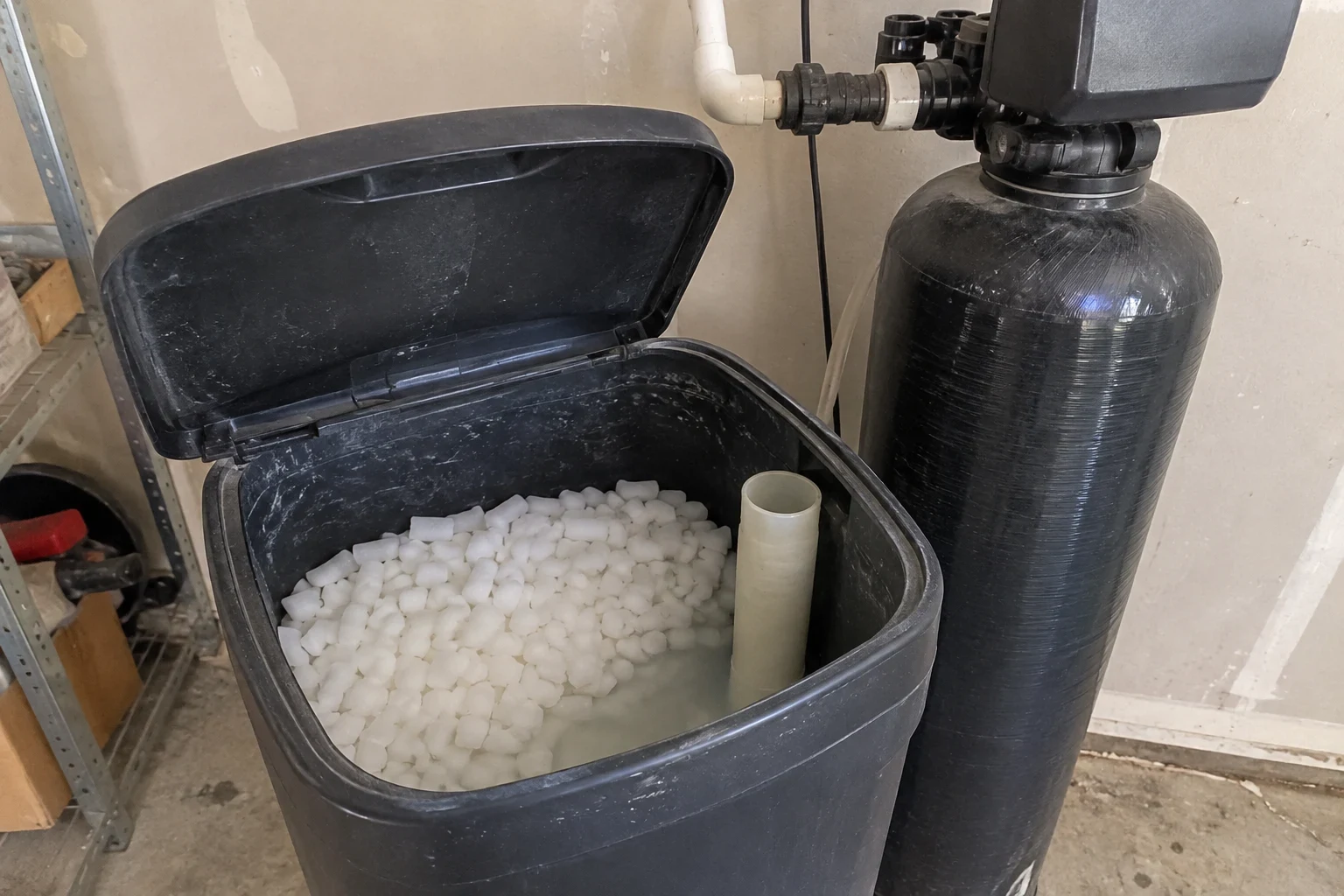
What should a water softener look like inside?
A healthy water softener has clean, round amber resin beads filling most of the tall tank with room left at the top, salt sitting above the water line in the brine tank with no hard crust, and a control valve with dry fittings, a secured drain line and no drips. If yours looks different, we can talk it through at (281) 694-0589.
The resin tank: the part you rarely see
The tall, narrow tank is the resin tank, sometimes called the mineral tank. On the outside it is usually a fiberglass shell, often blue, black or almond, wrapped around a plastic liner. Inside, it holds thousands of tiny resin beads about the size of coarse sand. Those beads trap the calcium and magnesium that make water hard and swap them for sodium or potassium.
Healthy resin looks like small, glossy spheres, amber to golden brown, and it pours like wet beads rather than clumping like mud. The tank should not be filled to the top. A good installer leaves open space above the resin so the bed can lift and loosen during the backwash cycle, which is what keeps the beads from packing tight and channeling.
Running down the center is a plastic tube called the distributor or riser. At the bottom it ends in a slotted basket that lets water through but keeps the beads in. Some tanks also have a layer of gravel under the resin to spread the flow evenly. A cracked basket or a riser cut to the wrong length is a small mistake that causes big trouble later.
- Good signs: round, shiny, amber beads with headspace above them
- Warning signs: dark brown or rusty beads, broken bead fragments, a mushy or compacted bed
- Resin beads showing up in faucet aerators or the toilet tank usually point to a damaged distributor basket
The brine tank: what you should see when you lift the lid
The shorter, wider tank is the one you can safely check yourself. Lift the lid and you should see salt pellets or crystals sitting loosely above any water at the bottom. Depending on the model, there may be a few inches of water or almost none between regenerations. Either can be normal.
Along one side you will usually find a tall tube called the brine well. Inside it sits a float or safety valve that stops the tank from overfilling if something goes wrong. Many tanks also have a raised plastic grid near the bottom so the salt stays off the floor of the tank.
In a hot, humid Friendswood garage, moisture can make salt stick together into a hard shelf called a salt bridge. It looks full from above, but there is an empty pocket underneath and the softener can no longer make brine. Push gently on the salt with a broom handle. If it feels like a solid roof, it needs to be broken up.
- Salt resting above the water, loose enough to move with a broom handle
- Water level well below the overflow fitting
- No sludge layer of dissolved salt, often called mushing, at the bottom
- An overflow line routed to a drain, not left open or capped
The control valve and plumbing: where installation details show
The control valve sits on top of the resin tank and runs the whole show. It decides when to regenerate, sends water backward through the resin to clean it, draws brine from the salt tank and rinses everything before you use water again. You will not see the internal piston, seals or injector without taking it apart, and that is a job for a technician. What you can see says plenty.
Look at the fittings first. They should be dry, with no white crust or green staining that would hint at a slow leak. There should be a bypass valve so the softener can be isolated without shutting off water to your home. The drain line should be fastened down and end with an air gap above the drain, so wastewater can never siphon back into the system. A drain hose that is loose, kinked or pushed down into a standpipe is one of the most common shortcuts we find.
We also look at what sits in front of the softener. Chlorine in city water slowly wears down resin over the years, so a carbon stage ahead of it can help the beads last longer. That is one reason we often talk about whole-home filtration and softening together.
- Dry fittings with no mineral crust
- A working bypass valve
- A secured drain line with a proper air gap
- A level base, with the tanks out of direct sun
When the inside means it is time for help
Some changes are easy to fix and some mean parts are wearing out. A salt bridge just needs breaking up. Resin that has turned dark and slimy may be fouled with iron and can sometimes be cleaned, though badly broken beads need to be replaced. Water standing high in the brine tank often traces back to a stuck float or a clogged injector in the valve.
If you are not sure whether your water even needs softening, start with water testing. A hardness test tells you how hard your water really is and how the softener should be set, so it regenerates often enough without wasting salt and water. Our full services after the sale mean we keep looking after the system once it is in, not just on install day.
More questions about softener parts
- Can I open the resin tank myself to look inside?
- We do not recommend it. Removing the control valve means draining pressure, handling heavy resin and reseating seals correctly, and a small mistake can cause leaks or lost beads.
- How often should I check the brine tank?
- Lifting the lid once a month is a good habit. Top up salt when it drops to about a third full and check for bridging while you are there.
- Does the color of the tanks matter?
- No. Shell color is a manufacturer choice. What matters is a sound tank, correct resin fill, a well-fitted distributor and a clean installation.
- Is my old softener worth repairing?
- Often it is, if the tank is sound and the valve parts are still available. We will look at what is inside and give you an honest repair-or-replace answer.
Not sure what you are seeing inside your softener?
Tell us what the salt tank and valve look like and we will explain what it means, what might need attention and what your options are. Get your quote by phone, and ask about free installation on new systems.